
AI they can defend.
Everything the care service has to know, keep, and be able to show. Your AI Secretary lives inside and knows the regulations and your own records. Let Mothy take some of the admin load, and get back to doing what you do best. Care.
An AI Secretary who works from your own records and the regulations.
Chrysalis is a private AI system for fostering services and children's homes, built by a foster carer. Mothy lives inside it. Ask him what the handbook says, hand him the notes from a shift, or have him draft the answers for a training workbook. He cites what he read, and nothing becomes the record until a person signs it.
An AI Secretary for your fostering service.
The system a fostering service runs on, with Mothy at the heart of it. The placement record, the daily log, the supervising social worker's caseload, training, claims and each child's health and school paperwork are all there, as you would expect. Mothy works inside all of it: he drafts the day from a carer's notes, finds the policy that answers a question and cites it, and reads a remittance off a photograph. And no AI company ever sees a child's record.

Real screen. Invented children.
An AI Secretary for your children's home.
The system a children's home runs on, with Mothy at the heart of it. The daily record and the handover, restraint, medication, the independent person's visit and the six-monthly review are all there, built the way the regulations ask for them. Mothy works inside all of it: ask him what the regulations or your own policies say and he answers with the source beside it, ask what is due and he tells you. And no AI company ever sees a child's record.
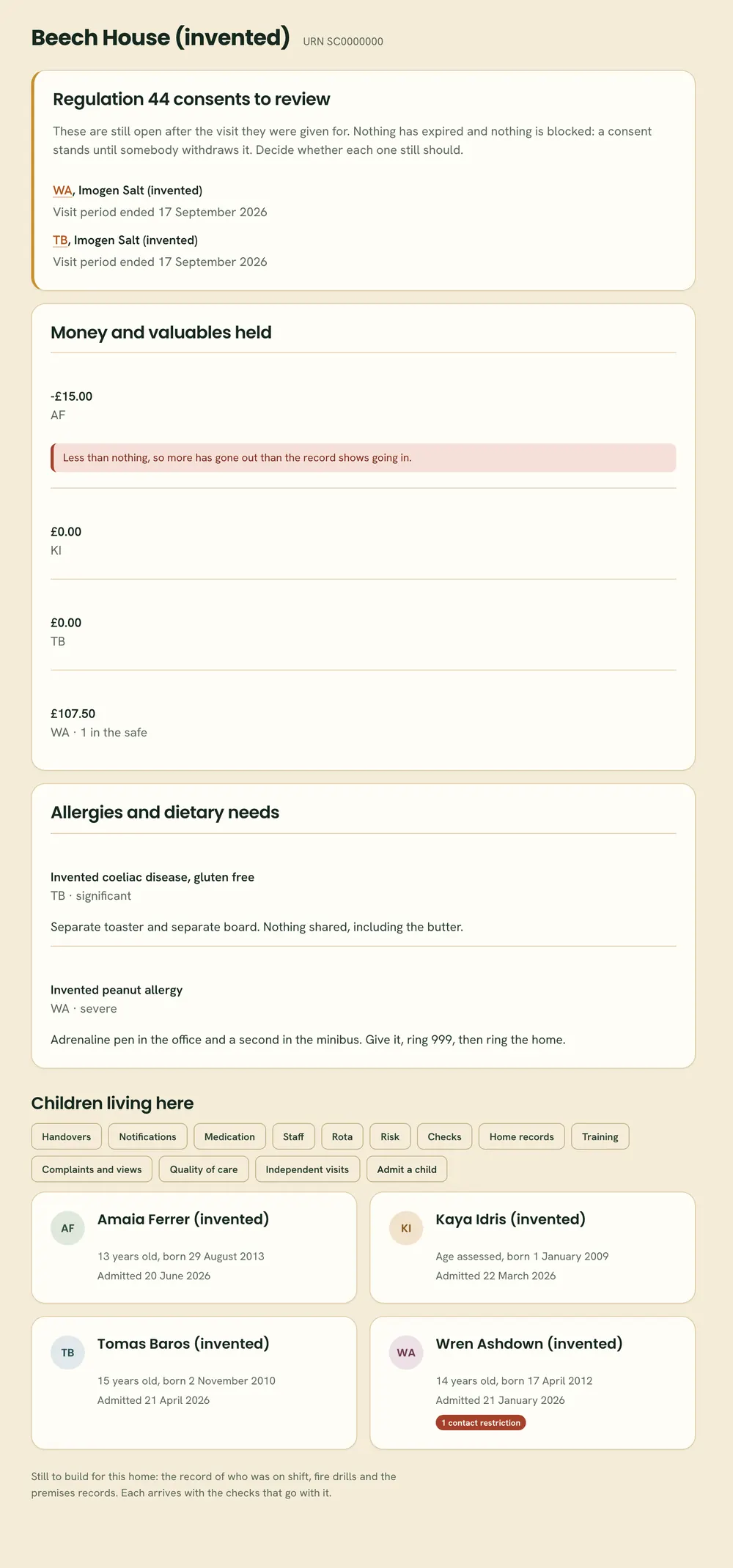
Real screen. Invented home.
Mothy shows his working.
AI is arriving in children's social care as a button on top of the record: a summary here, a one-click report there. Afterwards nobody can see what it read, what it wrote, or where a child's information went to be summarised. Mothy works inside the record, and leaves four things behind that an inspector can check.

-
01
He marks what he helped write
An entry carries the time AI helped write it.
No time means a person wrote it alone. The mark prints on the exported record and sits as a column in the spreadsheet, so whoever reads the file sees it without having to ask.
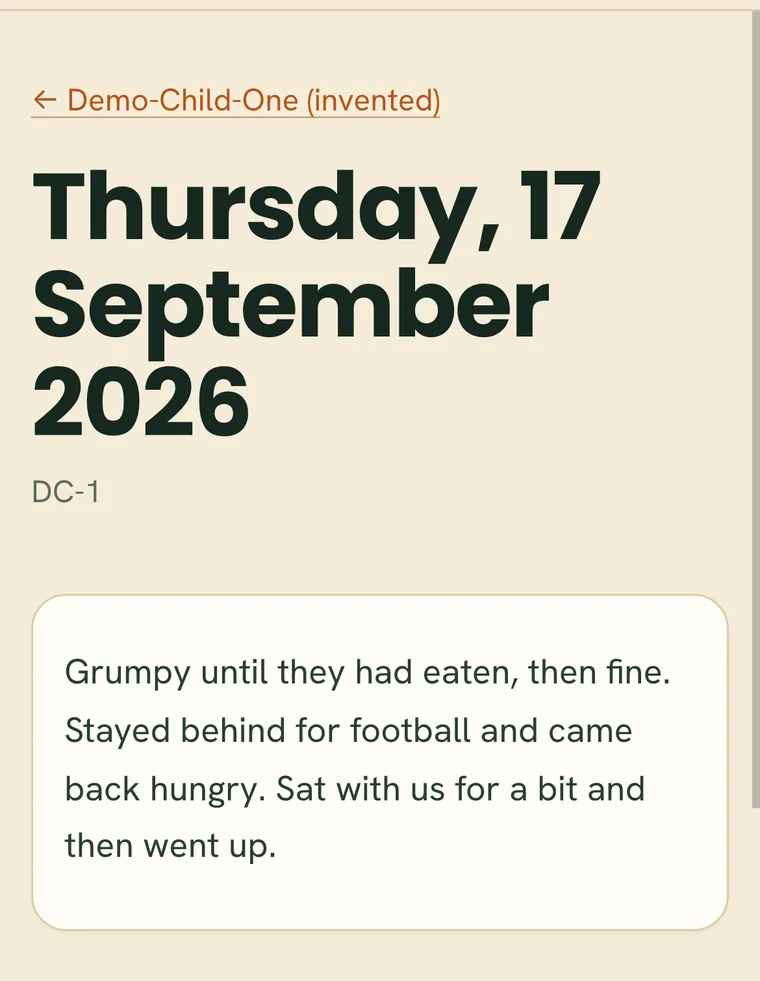
Real screen. Invented child. -
02
He shows his sources
An answer names the guidance or the entries it came from.
When Mothy drafts a training workbook answer, he names the days it was drawn from. When the caseload says something is due, the row names the regulation. Anyone can check the working.
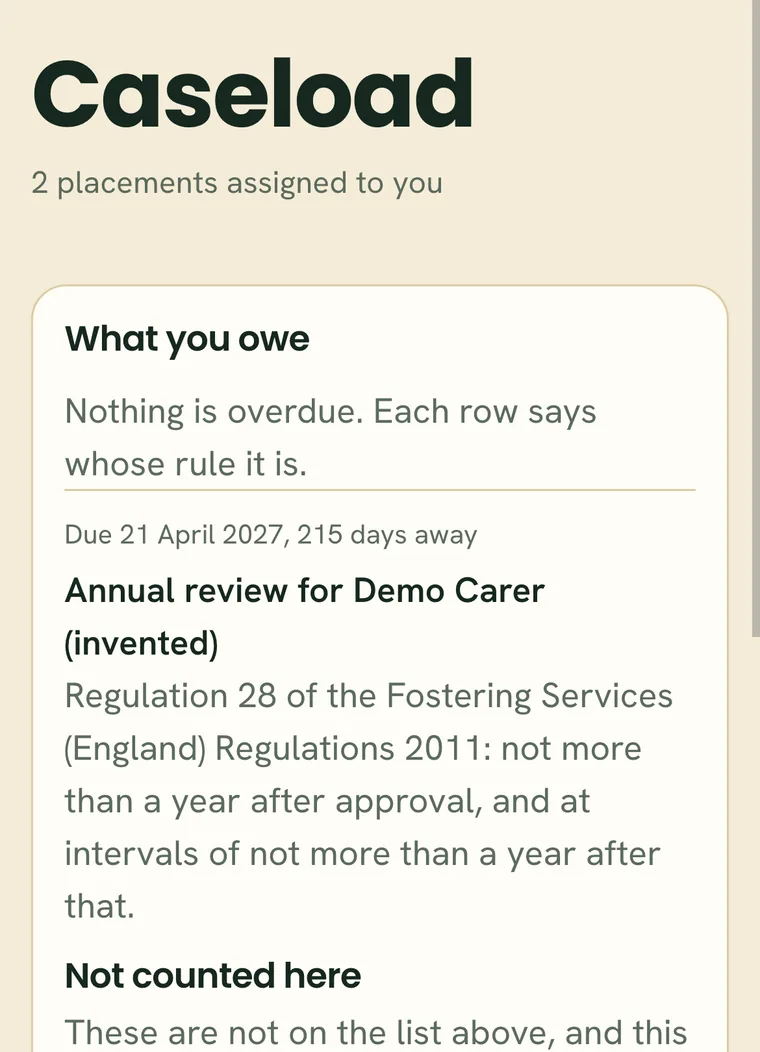
Real screen. Invented people. -
03
He asks when he is not sure
Where he cannot tell, he asks the person.
If a note could belong to either child, or a sentence could mean two things, Mothy asks. He does not pick the likeliest answer and write it down.

-
04
A person signs
What the model writes is a draft.
It becomes the record when someone reads it and signs a declaration adopting it as their own. The signature and the AI mark are written together, so they cannot disagree.
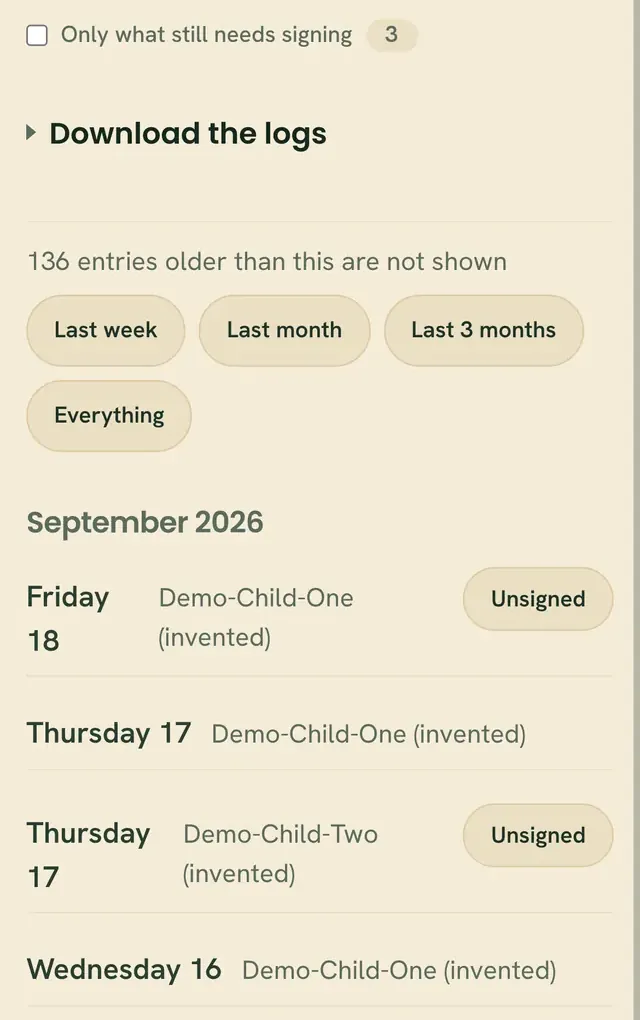
Real screen. Invented children.

Three steps, nothing to install.
-
1
Choose how it runs.
Dedicated, a system and database of your own. Or pooled, from launch: your own database, encrypted store, application node and private network, with AI inference pooled across customers. Both under UK jurisdiction, written into your contract.
-
2
Mothy reads your own records and the regulations.
Answers come from your material and the published guidance. Nothing is trained on your data.
-
3
Your team asks him questions and hands him drafts.
From any site or from home, over an encrypted private link. Every action lands in the audit log.
An audit log an inspector can check without asking us.
Every interaction is written to an append-only audit log, tamper-evident by design. It records what Mothy did and when.
Each entry is chained to the one before it, so changing any entry breaks the chain. That is how a service can show an inspector that a record has not been altered since it was signed. The export carries the chain and a verification report, and whoever receives it can run the check themselves, offline.
In fostering it aligns with Ofsted and the National Minimum Standards. In a children's home it is the record the Children's Homes Regulations ask for.
- timestamp
- 2026-09-17 21:32
- user
- Supervising social worker
- action
- Drafted training evidence
- read
- Daily logs, 3 to 16 Sep
- route
- your system
- evidence
- chained
Where the child's information goes.
A data protection lead asks these three questions before a child's record goes through any AI feature. These are our answers.
- Where does a child's record live?
- In a database and an encrypted store under UK jurisdiction, with that written into the contract. On the Dedicated tier they are yours alone, never shared with another customer. From launch, the Pooled tier pools AI inference across customers, while your database, encrypted store, application node and private network stay your own.
- Does any of it go to an AI model provider?
- No. There is no AI model provider anywhere in the chain. There is no API key to a model vendor, and nothing about a child is sent anywhere to be summarised. Nothing is trained on your data.
- What leaves, and who can see it?
- It connects only where you authorise it, and each connection is written to the same audit log as everything else. The data processing agreement names the traffic that does leave, which is monitoring, backup and updates inside the environment we run. There is one named UK processor, us, under that agreement.
One system, two ways to run it.
You never buy hardware and there is no capital cost. Prices are held for twenty four months, and nobody is billed by the bed.
A system of your own.
With its own database, under UK jurisdiction. For groups of homes, fostering services of 31 carer households or more, and councils.
Fostering from £1,650 a month. Children's homes from £175 a home a month. Founding places start at £1,000 a month, and in year two from £2,250 or your list price, whichever is lower. Six places. All six are open.
From launch: your own database, store and private network.
Designed and not yet live. With AI inference pooled across customers. For providers of one to five homes, and fostering agencies of up to 30 carer households. Pooled is not a founding place.
Homes from £175 a home a month. Fostering from £400 an agency a month.
Built for children's social care first.
Chrysalis is bought by the organisation that keeps the record, never by an individual carer. The people who use it every day are the carers, the staff on shift, the supervising social workers and the managers who sign.
Fostering services
A local authority's own service or an independent agency, on Chrysalis Luna.
Children's homes
From a single home to a group of fifty, on Chrysalis Atlas.
Councils
Children's services that have to defend AI to an inspector, an auditor and a subject access request.
Built by people who do this work.

Dr Geoff Richards, co-founder
Foster carer. Works in decentralised identity, data and privacy.
"I foster, and I built Chrysalis out of doing it. I have seen how sensitive this information is, and how casually technology asks you to hand it over. Chrysalis keeps it under your control and proves how it was used."

Tim Jackson, co-founder
AI, digital transformation, compliance and security.
"I have spent my career helping regulated organisations adopt new technology without breaking what keeps them compliant. Chrysalis gives them the benefit of AI, with the control and evidence a regulator expects."
Chrysalis AI is a product of Impending Tech Limited, with roots in UK fostering.

Six founding places.
Your number depends on your size and we settle it with you before anything is signed.