Runs a fostering service.
The child's health, education and life story. The carer's training, workbook and finance. The daily record, and the supervising social worker's caseload. One private AI system, on hardware reserved for the service alone.
The whole placement, in one record.
The customer is the fostering service, a local authority's own or an independent agency. Inside it three kinds of person sign in and each lands on their own screens.
The carer reaches
My day. The children, with their health, education and life story. Daily logs. Their own record: supervision, the annual review, reflection and documents. Training and deadlines. Schedule. Ask a question. Support. Finance. And a screen that says what this can and cannot do.
The service reaches
The caseload, with what is owed against each placement and whose rule it is. The carers. What we pay. The logs arrive with the supervising social worker rather than being chased for.
The child reaches
Their own journal and their own memories, in their own words, which are copied and never composed.
Every fostering service knows what it costs to recruit, assess and approve a replacement carer, and that keeping the one they have costs less. This is the part in between: the policy a carer needs at ten at night, the claim they are owed, the training record they will be asked about at their review.
- Your own policies, where a carer can actually find them.
- Regulation 17(2) of the Fostering Services (England) Regulations 2011 puts it on the service to take all reasonable steps to make sure its foster parents are familiar with its policies and act in accordance with them. A handbook at approval is how that is usually done. Here a carer asks, and the answer names the document it came out of, from the service's own files rather than a model's memory.
- Support outside office hours, on the phone in their pocket.
- The same regulation requires training, advice, information and support, including support outside office hours. The carer's support screen keeps the service's own out-of-hours numbers at the top, with the guidance and the handbook beside them. It does not stand in for the duty worker. It is where a carer looks at eleven at night before deciding they need one.
- The money questions, answered from the service's own rate card.
- Staff publish what the service pays: the allowance bands, the fee, the mileage rate, and the extras the handbook covers such as school uniform, birthdays and holidays. A carer making a claim reads the service's own published figure, and the mileage rate is already the starting number on the form. Their own side of it adds up to the summary an accountant asks for in January, with the Qualifying Care Relief limit worked out for the tax year. Those two tables are scoped in the database to the carer who owns them. Your staff hold none of it.
- A carer who moves to you brings their training record with them.
- The Training, Support and Development Standards follow the carer and whatever one service adds on top does not, so the two are counted apart rather than added into a single number nobody can unpick. A carer leaving takes their own training and their own answers, exported with a chain-verification report the next service can check without trusting either of us. Nothing about a child goes with it.
- A child's record built for the child.
- Health, education and the paperwork behind it, the EHC plan and the reports, held against the child rather than the carer who uploaded them, and gated per placement in the database on the same terms as the log.
The day, in the carer's own words.
A carer writes what happened whenever they get a minute. Nothing is the record until they sign it, and the clock on a note is the typing, not the event.
The record is tamper-evident: every entry sits on a hash chain, so a service can show an inspector that nothing has been altered since it was signed. It is also the carer's own. Their training and their own answers leave with them if they move service, and nothing about a child goes with it.
Real screen, scrolling. Invented children.

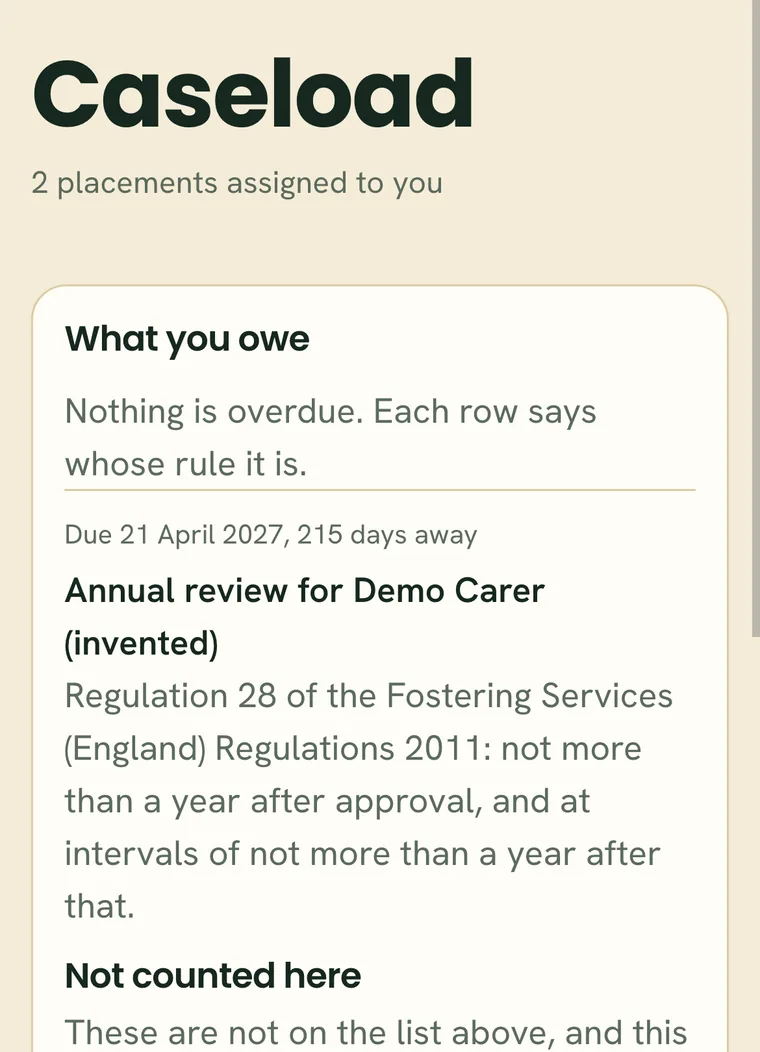
What you owe, and whose rule it is.
The supervising social worker works in the same system, on a different screen. The caseload lists what is due against each placement, and every row names the rule it comes from rather than asserting a deadline of its own.
Where nothing in law sets a frequency, it says so and asks the service for its own timescale instead of inventing one. It also spells out what is not on the list and why, because an empty list and a list nothing could be worked out for look identical.
The work around the writing.
Mothy writes the day up from the carer's own notes, and it is a draft until they sign it. Where it cannot tell whose log a note belongs to, it asks rather than picking one.
It drafts the answers in a training evidence workbook from entries the carer has already written, and names which entries each answer came from, so the carer can check the working rather than take it on trust.
It finds things in the service's own documents and answers from the fostering guidance, citing what it used. All of it runs on the service's own hardware and none of it goes to an AI model provider.

What it will not do.
- It does not write a child's voice. Their own words are copied, never composed.
- It does not fill a gap by guessing. Where it cannot tell whose log a note belongs to, it asks.
- It does not call an AI model provider. Any AI features are served from the service's own model box, and the log itself works with none.
- It does not put a child on the carer's portable record. What leaves with the carer is their own training and their own answers.
See it against your own service.
Founding places are open to fostering services who want the record on their own appliance.